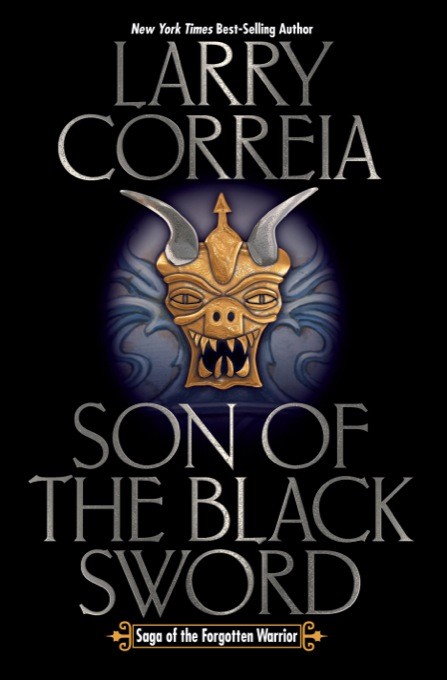
Son of the Black Sword comes out in paperback this week.
I am really proud of this one. It is my first attempt at writing an epic fantasy. I had a lot of fun with it.
Despite me not being a *real* author, Son of the Black Sword had done pretty good.
Sales were solid. Audio book sales were excellent (due to the fantastic narration of Tim Gerrard Reynolds).
This year SotBS has been a finalist for the Audie, AML, CLFA, Rampant Manticore, H Beam Piper Memorial, Gemmell Legend, and Dragon Award.
Shockingly, despite being considered a mere purveyor of hack pulp,I actually got some some good critical acclaim for once. It made Buzzfeed’s best of 2015 list, made Audible’s best of 2015 list, got a starred review on Publisher’s Weekly, was an LA Times pick, and I know I’m forgetting some other ones. I’ve never gotten “critical acclaim” before.
SotBS got a Jim Butcher cover quote. And true story, one day on Facebook fans were trying to decided who to vote for in the Dragon for best fantasy. Aeronaut’s Windlass is one of the other finalists. And this is a tough one, because the Venn diagram of Butcher and Correia fans overlaps a lot (though Jim’s circle is way bigger). But then Jim commented and said he thought SotBS was better.
I about died. What a class act (and brilliant author, if you’re not reading him you’re missing out).
But the best thing of all? I got Larry Elmore artwork! BOOM! Winning! 😀
The next two books in the Saga of the Forgotten Warrior are:
House of Assassins
Destroyer of Worlds
I’ll be working on the next one as soon as I finish up Monster Hunter Siege.
The voting for the Dragon Awards closes at the end of the month. Please spread the word and tell your friends. The Dragons are open to all fans, don’t cost anything, and they want as many fans as possible participating.
I would love for the first annual Dragon to have more fans voting in it than the Hugos.
Once you register here http://application.dragoncon.org/dc_fan_awards_signup.php they will email you your ballot. They send these out in batches, so make sure you give yourself time. If you registered, but not gotten your voting email yet, it might be stuck in your spam folder. It is from dcawards at dragoncon.
Aw, the Guardian’s Village Idiot Remembered My Birthday!
At least I assume that’s why I showed up in the pages of the pathetic Brit newspaper/bird cage liner The Guardian again on Saturday. Either because it was my birthday–and Damien knows I love piñatas–or it might have been that poor stupid Damien Walter needed the uptick in traffic again. The only time his goofy little opinion pieces get any traffic are when I make fun of them.
Or it could be that last week I wrote an article about the sorry state of the US media, and the Guardian took that as a challenge.
For those of you not familiar with Ace Reporter Damien Walter, you are in luck. Just go up to this blog’s search engine and type in “Village Idiot”, and a whole bunch of fiskings of his goofy/snooty ramblings will pop up. Every time I say something about how modern sci-fi fandom has gone so PC that it has shoved its head up its own ass, and some person thinks I’m exaggerating the state of things, along comes another Damien column, and that person is like “Damn, son. It’s worse than you said.” Truly, Damien is the gift that keeps on giving.
Since the Guardian is falling apart financially and laying people off, I can only hope that Damien is able to cling to employment. Ha! Who am I kidding? I doubt the Guardian actually pays him! He should be safe.
I might not bother fisking the whole thing, because poor dimwitted Damien’s latest jackassery is even more pedantic and boring than usual. It’s another article where he pretends to have read books before reviewing them. I’ll just hit the highlights.
Basically, Damien read some Wiki synopsis or the first few pages of various books, and then put on his Wannabe Literature Professor hat. Because those who can do, do. Those who can’t, teach. And those who can’t even do that take grant money from the British government to write a novel and then run off to Thailand to chase Lady-Boys.
Original is italics, my comments are in bold.
Hugo awards: reading the Sad Puppies’ pets
The rightwing lobby are gunning for books to win the sci-fi awards that match their ideological project. They really don’t care about writing well
By Damien “Never Had a Proper Male Role Model and Is Still Very Upset Someone Made Fun Of His Hair Cut In Middle School” Walter.
For the last few years, the Hugo awards for science fiction have been campaigned against by a group of writers and fans calling themselves the Sad Puppies – mostly male, very white, and overwhelmingly conservative.
In true Olympic spirit, Damien is off to a great start by cramming several lies into the opening line. It isn’t mostly male. In fact, it was run by three women this year. The Sad Puppies don’t care what color anybody is (ironically in the USA, I’m supposed to check the Latino box, which is annoying because I think checking any box is stupid). And last but not least, I’d say most of us are probably more libertarian than conservative.
Unhappy with sci-fi’s growing diversity, the Puppies have deliberately block-voted for certain titles to get them nominated for Hugos at the expense of a wider field.
Another lie. If by “diversity” Damien means the year I really got going on this topic the winners were 14 white liberals and 1 Asian liberal, and people like him hailed it as a “triumph of diversity”, sure. Run with that.
They say it is their goal to “poke the establishment in the eye” by nominating “unabashed pulp action that isn’t heavy-handed message fic”.
Yeah. I just couldn’t handle any more dying polar bears or robot rape.
I say it is to sponsor awful writers.
And Damien is an expert on awful writing.
The Puppies have two criteria for what they deem excellence: does it turn a buck? And has the author dared to say anything, ever, that they disagree with?
Nope and nope. Two more lies.
Never disagree with? SP1 and 2 was mostly me throwing some stuff together that I liked, and I nominated works by several people who I disagreed with politically. Damien conveniently forgets that part where one of my novella nominees was a liberal democrat, who was immediately set upon and attacked as a “racist neo-con” because I liked his story (Remember, back then the WorldCon crowd wouldn’t actually come out and admit the whole thing was political, which was the point I was trying to prove).
If you look at the SP3 nominees, they are clearly all over the board politically, philosophically, racially, sexually, or by any other metric you come up with. SP4’s suggested nominee list was put together out in the open, democratically, with input from anyone who wanted to participate. And to put a cherry on top of how obviously idiotic this accusation is, a few of those nominees “disagreed” with us by dropping out due to political pressure from Damien’s friends.
Scratch that. Damien’s side. Damien doesn’t actually have “friends”.
Making a buck? Well duh. It’s a FAN POPULARITY AWARD, moron. When books nobody ever actually buys are winning your fan award, that should be a warning you’ve got a problem.
This, paired with their conspiracy theories about some big sci-fi publishers, means that they tend to champion mostly self-published authors.
One more line, two more lies.
In an award system where a category came into existence simply so Patrick Nielsen-Hayden could finally get a trophy, somebody with clout and reach got a dozen media outlets—who never covered the Hugos before—to run matching stories about sexist/racist invaders in the same 24 hour period, but conspiracies are absurd! – Says the reporter who somehow knew I was a finalist before the announcements were made.
And the vast majority of SP nominees have been traditionally published. I do believe however that we were the cause of the first ever nominations for self-published or shockingly, media tie-in works.
Which tells you a lot more about the snobbish nature of the Hugos than it does about us.
Nothing about quality
Lie. In fact, going back to the very beginning I was saying that the quality of any given work had become irrelevant compared to the author’s politics or ass kissing ability.
– though you don’t need an in-depth knowledge of sci-fi to understand that a short story called Space Raptor Butt Invasion (yes, really) has not arrived on the Hugo lists because of its calibre.
Another lie. Space Raptor Butt Invasion was not a Sad Puppy nominee. It was nominated by an offshoot group which started during SP3, called Rabid Puppies. They have different goals and methods. Damien, and everybody who has paid a lick of attention, knows this. They just like to confuse the two whenever it is convenient.
Oh, and Space Raptor Butt Invasion is still more award worthy than If You Were a Dinosaur My Love… Because Chuck Tingle is hilarious and love is real.
With this year’s Hugo awards coming on Saturday night in the US, I thought I’d read some of the authors championed by the Puppies. (Don’t ever say I don’t do anything for you.)
Judging by how pathetic these reviews are, trust me, he still hasn’t done anything for you.
If you find meaning in straight-to-video Dolph Lundgren films, then Larry Correia’s novels will be your kind of read.
Wait… Is he comparing me to Dolph Lundgren, the ripped 160 IQ chemical engineer, turned Red Mother Fucking Scorpion, Ivan “I Will Break You” Drago, and all around bad ass… as an insult?
He left out the turned Machinegun Dealer part, which is what if I recall correctly, was what caused Damien to begin wetting the bed about me to begin with.
kicked off his Monster Hunter series with Monster Hunter International, about an accountant whose boss turns into a monster.
News flash. Guardian Book Reviewer reviews an author’s debut novel seven years late.
So he shoots him. In fact, much of the Monster Hunter series relies rather heavily on people the hero doesn’t like turning into monsters … so he can shoot them.
Another lie, but it just demonstrates that Damien merely skimmed the first chapter so he could fake a review.
The bit about the series relying heavily on people the hero doesn’t like turning into monsters so he can shoot them? I found out about this article when somebody shared it to the MHI fan page on Facebook. Nobody there could think of any other cases over five books where somebody the hero didn’t like turned into a monster so he could shoot them. The closest anyone could think of was the opposite happening.
You know what they say about assumptions, Damien? They say when you in particular make them you’re probably going to be wrong, because you’re a dope.
Speaking of assumptions, this is the same guy who published that I was a sexist/racist/homophobe, who when confronted for evidence, then crowd sourced a witch hunt of all my copious political writings to find something bad I’d said. And the best thing they could come up with was my teaching free self-defense classes to women (so they could shoot rapists in the face) was “victim blaming”.
Sadly, Correia’s books are not quite awful enough to be good. They’re just mediocre.
Isn’t it a little weird that Damien chose to talk about my debut novel from 2009, rather than my 12th novel, Son of the Black Sword, which would have been the book eligible for this period? Because that book was picked as one of the best books of the year by the LA Times, Buzzfeed, and the Science Fiction Book Club, has gotten critical and even academic acclaim, and has been a finalist for the Audie, Gemmell Legend, AML, CLFA, H. Beam Piper Memorial, and Dragon awards.
Go figure.
That’s fine – Dolph Lundgren movies are also often mediocre, but plenty of people like them.
And more than anything else here, that one sentence demonstrates why Damien is a fucking tool.
Damien? Never heard of her.
But did Lundgren’s Masters of the Universe deserve to take the 1987 Oscar over Oliver Stone’s Platoon? I don’t think so – and in that same way, Correia’s novels in no way merit consideration for the Hugos (thankfully, he only made the 2014 longlist).
Actually, dipshit, I made the 2015 longlist also, but immediately asked them to remove me from the list, and then I recused myself from all future Hugo nominations, so that you mopes couldn’t carry on your ridiculous narrative that Sad Puppies was all because I personally wanted a Hugo.
Dave Freer’s Changeling Island, shortlisted for this year’s inaugural Dragon awards, is all about story – which is fortunate, because sentences as thoroughly mangled and amateurish as Freer’s won’t be winning any prizes (at least I hope not).
Compared to Dave’s writing, Damien is finger painting with his own poo.
Open with a strong start, they say; now read Changeling Island’s opening:
It had been the most terrifying, miserable day of Tim Ryan’s whole miserable life. He’d just done it to show Hailey. Because … because she said he was too scared. He was. Every time he tried anything it always went wrong. Horribly wrong. And he wasn’t a thief. Well, he didn’t want to be. It was one of the few thing things his dad ever really got angry with him about. And then he’d only been a little five-year-old kid helping himself to a chocolate bar in a store. But Hailey … she said … and he’d do anything to get her.”
Editor hat on (and unlike Damien, I’ve actually edited stuff people have paid money for). The purpose of an opening line is to serve as a hook to make you want to read more. It makes a promise. This is a YA book, aimed at young adults. We meet a character, and from the voice/tone, we can see it is a kid, he’s nervous, and he lacks confidence. Now the reader wants to know why, and reads the next sentence. And the next. If they made it that far, they just bought the book.
Mission accomplished. Except for Damien, because apparently Dave didn’t write that to hook the Sanctimonious Fucktard market.
Funny Damien didn’t pick the opening line of MHI for some reason.
On one otherwise normal Tuesday evening I had the chance to live the American dream. I was able to throw my incompetent jackass of a boss from a fourteenth-story window.
Damn right. And that opening line has probably made me a million bucks now. I bet Dolph Lundgren would love that opening. If Damien had put that in the Guardian, with its readership numbers, I might have sold another one, maybe even two, books!
In fairness … to Freer … pick any passage, from. Any Puppy author like Brad Torgersen or Sarah Hoyt and you will find … sentences … as mangled as these.
Oooooh, this working author used too many ellipses in a paragraph to indicate a young character was hesitant and correcting himself! says the knobtosser who has only published a handful of short stories (to such a pathetic reception that I can’t even find them on an Amazon search).
But at least Damien skimmed one whole chapter of my first book before writing a review. Dave only got one paragraph!
By the way, Sarah Hoyt started out writing “LITERATURE”, and got a lot of critical praise, but switched to stuff people actually like to read because the pay was crap. Brad’s background was in short fic, where he kept winning that Analog Reader’s Choice award, and before his badthink politics came to you guys’ attention SFWA thought he was good enough to nominate for a Nebula.
Within the Puppy movement, John C Wright is considered to be its resident intellectual colossus and was nominated three times for the 2015 best novella category (which eventually went to no one).
Objection, your honor. The prosecution is conflating the two puppy movements again, because this article is supposedly about Sad Puppies, but only one of those nominations were from the Sads and he knows it.
Sustained. One more outburst like that, Mr. Walter, and you will have to look upon this photo of Dolph Lundgren in order to dwell upon your own pathetic existence in comparison.
I will break– Never mind. It appears you are already broken. Please, Damien, stop crying. You are making me uncomfortable.
He is hugely influenced by the Inklings, particularly CS Lewis. But in comparison to Lewis, whose metaphysical investigations were built up from wide-reading during a lengthy education,
Uh, actually Wright got an education, graduated law school, was an attorney, then a reporter, then a newspaper editor, and back before he became known as a staunch Catholic he was so beloved by the literati they nominated him for a Nebula (an award which only SFWA members can vote for).
Funny how Brad and John were both *real* writers before their politics became well known…
Wright reads like a first-year humanities undergrad who refuses to read beyond a small pool of comforting favourites, writing essay after essay (or novel after novel) only to demonstrate how much he knows.
I was wrong earlier. Damien has one friend. Projection. In this case the “essay after essay trying to sound smart” part, because Damien is way too incompetent to get his novel finished.
Consider this dialogue from Wright’s The Phoenix Exultant:
Rhadamanthus said, ‘There is a tension between the need for unity and the need for individuality created by the limitations of the rational universe. Chaos theory produces sufficient variation in events, that no one stratagem maximises win-loss ratios. Then again, classical causality mechanics forces sufficient uniformity upon events, that uniform solutions to precedented problems is required. The paradox is that the number or the degree of innovation and variation among win-loss ratios is itself subject to win-loss ratio analysis.
Oh, look guys, Damien picked a dialog paragraph with no context from a book. You have no idea who the character is, or what they’re talking about, or what that paragraph is supposed to convey. Is the character actually smart? Trying to impress someone? Is the information meant to confuse someone else? Who is he speaking to? Have these ideas been discussed previously?
Well there you have it, folks, books have beginnings and page numbers for a reason.
That random sampling of one paragraph is a bullshit review method. You could do the same thing to Dune, Hyperion, or Cryptonomicon, and cherry pick some information dense, confusing when out of context paragraph too. It doesn’t mean those books aren’t fucking amazeballs.
That is why we have Book Reviews and not Paragraph Reviews (unless it is the Guardian, because we should just be thankful those lazy socialists show up to work at all).
Though this reminds me of an incident with the Imbecile Stalker Troll Clamps, where he was all hung up on what were author’s best lines, and his was something about globes of light floating like fish semen or some bullshit. I said my best line was The End, because that meant I’d finished another book and now I could get paid for it. Wannabe artistes get hung up on individual lines. Working authors tell stories.
This goes on, for page after page.
Actually, no it doesn’t.
The characters are no more than ciphers for Wright’s ranting, and what story exists is only glimpsed in momentary fragments between diatribes. After long enough reading Wright, you start to suspect that he, like most of these authors, simply can’t help himself, vomiting on to the page whatever passes through his head.
Maybe you should try “vomiting” stuff onto a page, Damien. Then you might actually finish that book and quit ripping off the British tax payers with your book welfare. Whatever your current method is doesn’t seem to be working.
But the funny thing is, for those of us who have read Wright, we know that his stories vary a lot in style depending on what kind of effect he’s going for. Sometimes he does big brain sci-fi, other times he writes borderline Narnia. Personally, my favorite is his Nightlands stuff.
At this point, we must be reminded that these are amazing times for science fiction and fantasy storytelling.
Something I agree with, but for entirely different reasons. Back when gatekeepers controlled what made it to market, jock sniffer wannabe pundits like Damien actually had a small measure of power. Now they are increasingly irrelevant.
Not really. That’s what Damien found in ten seconds of Googling. Anything more exhausting would require him to take another mental health holiday.
And the hack writers and sloppy sentences championed by the Sad Puppies deserve no place in that picture; for their politics, yes, but also their sheer shoddiness.
I love when they slip up and admit that it is actually all about politics.
But the Sad Puppies don’t want any of their books to end up on bestseller lists or TV screens.
That is quite possibly the stupidest thing Damien has ever written, and that’s saying something.
First off, all authors want our books on bestseller lists and TV screens. Duh.
Second, I’ve optioned the rights for an MHI TV show to Entertainment One (the Walking Dead people). They teamed up with Sky Network and brought in a team of screen writers. We just renewed the contract this year. It is in development. Knock on wood.
And third, last week the latest MHI novel was the #1 bestselling fantasy hardcover in America on Nielsen Book Scan (the most accurate of all bestseller lists).
So literally, while Damien typing up this dreck about how we don’t want to be on TV or bestseller lists, I was on a bestseller list and cashing option checks.
You can’t make this stuff up.
And I’m not the only SP nominee to be a bestseller or have optioned stuff for movies. SP3 and SP4 nominee Jim Butcher is a #1 bestseller and already had a TV show. We nominated bestseller Kevin J. Anderson, who has written for like a dozen movie and TV franchises.
Shittiest. Reporter. Ever.
It’s the same frustrating paradigm that British MP Michael Gove hit upon when he said that people were sick of experts, or what Donald Trump plays upon when he rails against “professional politicians”.
I don’t know what the fuck lame ass comparison Damien is trying to draw here. But he thinks comparing me to Dolph Lundgren was an insult… so thanks? I guess?
We’re seeing the Dunning-Kruger effect played out on a mass scale, and the Sad Puppies are just a speck in that wider problem.
BWA HA HA HA HAAAAAAAAAAA HA HA! Snort.
Oh wait… Dear Lord. He’s serious. Sometimes I can’t tell if Damien is such an ideological shill that he is compelled to say stupid shit, or if he’s actually as mentally defective as he comes off.
Regardless, for those who aren’t familiar with Dunning-Kruger, that’s the phenomena where the less you know about a particular topic, the stronger your opinion tends to be, with the truly ignorant being the most opinionated. The more you learn about the topic, the more uncertain you become, until you achieve actual expertise, and then your confidence in your conclusions increases.
The subject under discussion is WRITING BOOKS PEOPLE WANT TO READ. On one side, Damien cites me, Dave, Sarah, Brad, and John, who between us have published like 40 million words of paying fiction, as being shitty writers. On the other hand, we have a clueless wannabe dilettante hanger-on who has failed to publish anything, who is so certain he knows the market that he can judge entire careers based on a paragraph.
Yeah… Draw your own conclusions about who goes where on the Dunning-Kruger graph.
Projection is truly Damien’s only friend.
EDIT! Because this is too awesome not to share, this was pointed out on FB while I was putting this up, Damien’s first short fiction sale was in 2005. In 2008 he attended one of those fancy expensive writer’s workshops. That means that Damien has been trying to be a professional writer LONGER THAN I HAVE.
I didn’t watch any of it. I painted minis instead. I’m going off of the discussions I saw on Facebook this morning.
I hung it up after 2015’s Celebration of Wooden Assholes and didn’t participate in 2016. I figured it would shake out like this, the elitist cliques would circle the wagons, send a message that outsiders can fuck off, and declare whatever happened a victory for “diversity”.
Funny. When I started Sad Puppies four years ago, the narrative was all about how the Hugos were a celebration of what was great, representing the best of all of fandom. I said nope, it is decided by cliques, ass kissing, and politics. They called me a liar. Fast forward to now, and at least they are open it is all politics. Hell, they’re celebrating it.
Just ask yourself this, what kind of scumbags would give No Award to Larry Elmore? This is a man who is one of the most prolific and popular fantasy artists of all time. His covers dominated the better part of a decade, a whole generation of writers grew up with his posters on their wall, yet, he never got nominated for a Hugo that entire time.
Larry Elmore wasn’t involved in any campaigns. When he found out that fans finally recognized him for a Hugo nomination he was surprised, honored, and humbled.
No Award.
Moira Greyland exposed to the culture of rape and pedophilia in old fandom, and not the made up “rape culture” the modern feminists accuse anybody who disagrees with them of. It was a gut wrenching expose in a category normally won by fluff. But they wanted that swept under the rug.
No Award.
Toni Weisskopf? No Award. But we already knew that was coming. Sure, she’s one of the most successful editors and publishers in the business, exactly the sort of “empowered woman” these liars claim we want to keep out.
And Jerry Pournelle… Living legend. You pieces of shit are honestly going to tell us that Jerry Pournelle is not award worthy?
Sure. Why not?
And to Neil Gaiman, boldly standing up to those pesky Puppies during his speech…
When you got your buddy Jonathan Ross to volunteer to MC the awards, it wasn’t those jerky Sad Puppies that formed an angry twitter mob because he *might* tell a fat joke. He got sacrificed on the altar of PC.
When you were getting yelled at for making light of Trigger Warnings, it wasn’t the Sad Puppies who were triggered.
And when some dilettante couch surfer was demanding that readers judge authors by the color of their skin rather than the content of their books, and holding up your book as the example for her finger shaking scolding, it was the Sad Puppies who said that was nonsense.
Now, I know you’re a multi-millionaire A-lister and your career is so awesome you can safely pat those yapping jackals on their tender heads and not lose a hand, but most authors aren’t in your lofty tower. When the angry mobs come for them, they’re fucked. Names get ruined, contracts get cancelled, and careers are derailed.
But instead of standing up to the Outrage of the Week crowd, you stood up against those jerky puppies. (by the way, Neil, there were two separate groups of Puppies with entirely different goals and methods, but I’m sure you knew that before you told them all to sod off). So way to go. You showed them.
So all this latest nonsense sure makes me glad I didn’t waste any time on the Hugos this year. What a joke.
Louisiana floods. Tens of thousands flee their destroyed homes. Billions of dollars in damage. Unknown number of deaths. Huge natural disaster.
But several days in and I’m still running into people who are like, huh? A flood in Louisiana? You mean Hurricane Katrina, right? They haven’t heard a thing about it.
That’s because the American news media looks at every single event and asks itself a few simple questions before they decide how much coverage to give something.
First, is there anything we can milk from this story to bolster our worldview? Y/N
Yes. Cover the shit out of it 24/7 breathless panic attack, and demands that we DO SOMETHING. (said something is almost always give the government more power).
No? Meh.
Second, is there anything in this story which could potentially make democrats look bad? Y/N
Yes? What emails? Fuck you.
No? See #3.
Third, is there anything in this story which will make republicans look stupid or evil? Y/N
Yes? Holy shit! Run it! Run it! New Orleans has been utterly destroyed because George Bush controls the weather and hates black people and his incompetence and evil racism has ruined this once beautiful American icon of– (and put that on a loop for the next three weeks)
No? Do we need any filler?
#2 and #3 are for most major media since they predominantly swing left, but for Fox you can just flip the democrat/republican, and they’re just as bad.
Fourth, does this event in some way affect us personally? Y/N
Yes? DROP EVERYTHING! RUN THIS OR WE ARE ALL GOING TO DIE!!
No? Eh… we’ll talk about it for a minute if we’re not too busy.
My favorite example of that last one was from several years ago. Different flood, Tennessee this time. And a river was about to break its banks. About fifty thousand homes were in immediate danger. The news was in the middle of saying which counties needed to run for their lives so as to not drown—
WE INTERUPT THIS REPORT FOR A VERY IMPORTANT BREAKING STORY
And then, I shit you not, the news flipped to Times Square in New York City, where GASP, somebody left a cooler unattended. COULD IT BE A BOMB?! This is literally down the street from our offices, and Dear God, it could be terrorists! We go now live to where the NYPD has moved people away from this Murder Death Bomb and have called in their Bomb Squad in their big scary Hurt Locker suits. Go ahead NYPD Lieutenant!
Bored looking NYPD cop: “Uh, the bomb guys are gonna go poke it. Don’t worry. There’s no need to panic. It’s probably just a cooler that some tourist forgot, which happens like ten thousand times a day here and at every other tourist spot in the world. Odds are it isn’t terrorism, but we always check to make sure. I don’t even know why you’re filming us.”
You heard the NYPD WE ARE ALL GOING TO DIE!
And then they covered it for the next forty minutes straight. With the cameras all pointed at this Styrofoam container LIVE because it is going to BLOW any second! And all of these nervous anchors talking about it in hushed tones while I’m thinking, you know, I’ve got friends in Tennessee, I wonder if they’re running in front of a tidal wave right now? And the news was like FUCK SOUTHERNERS CAN’T YOU SEE THERE IS AN UNATTENDED COOLER HERE WHERE WE LIVE?! Oh, wait… And the NYPD confirms it contains sandwiches.
But then fifteen minutes of analysis about the sandwiches later, and experts pontificating on the fear inherent in unattended sandwiches… what were we talking about before all the excitement? Oh… Yeah… And everybody in Tennessee has died. Very tragic. So anyways, let’s see what this movie star wore to some party none of you were invited to—
If you keep these four simple questions in mind you can predict with quite a bit of accuracy how many minutes of airtime a story gets, the size and position of newspaper columns about it, and how prominent it will be on websites.
Let’s say there was a mass shooting.
#1. The media loves it some gun control, so initial reports will be how we have to DO SOMETHING!
#2. If it turns out to be a white boy off his meds, then they’ll continue to cover the hell out of it. But if it turns out to be a Muslim yelling Allah Akbar right after the democrat president told everybody terror is contained or that if you’re worried about Muslim refugees it can only be because you are racist, then the coverage drops.
#3. Did the current GOP candidate for president say something stupid about the event? (pretty good odds of that!) Let’s talk about his stupid comments about the event instead of the actual event.
#4. All this is moot if it took place somewhere the reporters actually give a damn about. Garland, Texas? Ha!
Change the shooting around. Random good guy shoots the bad guy one minute in? Zero coverage. Which is why when I’m arguing against gun control folks, and I bring up Random Good Guy With Guns making a difference, and they proclaim that never happens, and I immediately list off a dozen… They stare at me blankly. Those events never get reported because of the media world view.
Change it around again. A psycho who has glommed onto Black Lives Matters murders a bunch of cops. That’s a tough one for our noble reporters, because they really want to push gun control, but they’ll let it slip after a day or two so they can go back to their regular narrative about racist cops gunning down choir boys who were just standing on the corner minding their own business.
Are there bad cops making bad shoots? Sure. But you wouldn’t ever know how many because the media is too fucking stupid crying wolf about everything, justified or not, to ever actually delve into anything as complicated as Use of Force laws.
These simple questions explain why some terrorist attacks get covered, and others don’t. If they can spin the terrorist attack to be about gun control, then they’ll cover it a lot. But then when the same exact kind of attack happens in a country that has incredibly strict gun control, it’ll be a human interest tragedy story, which will quickly fade from the American news in a day or two. And if it is a Muslim terrorist attack in a 3rd world country (like the vast majority of them are in reality) then it will get absolutely zero coverage, and very few people in America will have a clue what you’re talking about.
Mumbai? Westgate? Blank stares.
These biased jackasses never come anywhere near the truth. It is all about narratives bolstering existing world views. I’ve been involved in a bunch of news stories over the years, and the resulting reports seldom have anything to do with the reality.
Think about any topic you are an expert on, and then think about how pissed off you get when you see the news fuck it up. Problem is, they suck that much at everything.
“Briefly stated, the Gell-Mann Amnesia effect is as follows. You open the newspaper to an article on some subject you know well. In Murray’s case, physics. In mine, show business. You read the article and see the journalist has absolutely no understanding of either the facts or the issues. Often, the article is so wrong it actually presents the story backward—reversing cause and effect. I call these the “wet streets cause rain” stories. Paper’s full of them.
In any case, you read with exasperation or amusement the multiple errors in a story, and then turn the page to national or international affairs, and read as if the rest of the newspaper was somehow more accurate about Palestine than the baloney you just read. You turn the page, and forget what you know.”― Michael Crichton
So we’re all walking around, thinking we’ve got a clue about stuff, when in reality we’ve been fed bullshit by idiots.
The left side of media requires everybody to be secret angry racists (other than them, obviously), and racial incitement makes great TV. So, cop shoots a white dude. Nobody cares. Cop shoots a black dude, before the crime scene people have even finished taking pictures and nobody has a clue what actually happened, it is getting tons of coverage. People get pissed. And if the news gets lucky somebody burns a Walgreens, which makes for great ratings.
If you watch the news you’d think that America was dissolving into this ultra-violent mega crime wave. When in actuality our murder rate is way down (When I was in Europe recently, everybody I talked to thought that America was like Mad Max, which tells me their news sucks as much as ours does) There are a handful of urban areas with lots of violent crime, but the rest of America is actually pretty damned peaceful (probably because we all died in floods the media never covered).
But, see #4. The media is based out of these big urban areas. Which is why they don’t give a shit about Louisiana or the rest of us, unless of course, they can somehow milk our tragedies for political points.
When it comes to politics this bias is taken to an absurd level. There are plenty of legit reasons to despise either presidential candidate. But what is most political coverage about? Stupid minutia, half of which is made up. So when you get into a discussion with a zealot who has been educated by watching their side’s news, the debate turns into clueless garbled soundbytes, and half the time they don’t even have a clue what you’re talking about, because it never made it past #2 or #3 to get covered.
Or worse, it was so big the media had no choice but to cover it, but they did it so flippantly or dismissively that people think it was no big deal, or they go into partisan excuse making damage control mode to minimize it. When in reality it was a colossal fuck up, where if there was any integrity left in the process, the people involved would have gotten tarred and feathered.
No policies are ever looked at based on what they’ll actually do, it is more, rah rah, go team. Notice that when they were trying to pass Obamacare all of the news coverage was sob stories about poor sick people denied coverage? That’s because all of that pesky accounting saying the thing was destined to choke didn’t fit the worldview. And now that it is falling apart (like everybody who could do math predicted it would) is there much coverage? Don’t be silly. Once it implodes I’m sure it will come as a huge shock, which will cause another big crisis which requires them to DO SOMETHING.
This bias is why the news either portrays vets as poor illiterate dupes sucked into the Imperialistic war machine because you couldn’t get real jobs (like a Barista or HuffPo contributor) so somebody needs to DO SOMETHING or you’re a war mongering ticking time bomb of PTSD addled murder rage waiting to explode in an orgy of violence, and somebody needs to DO SOMETHING.
This absurdist, pundit, echo chamber bullshit just keeps getting more and more obnoxious.
Now you assholes can’t even be bothered to talk about one of the biggest natural disasters in recent history, because it might somehow smear your dude.
And after all this, the American news media is simply baffled that nobody trusts them anymore. No shit, Sherlock. That’s because you suck. The sooner you dinosaur hacks plod off and die from shitty ratings, the better off we’ll all be.